

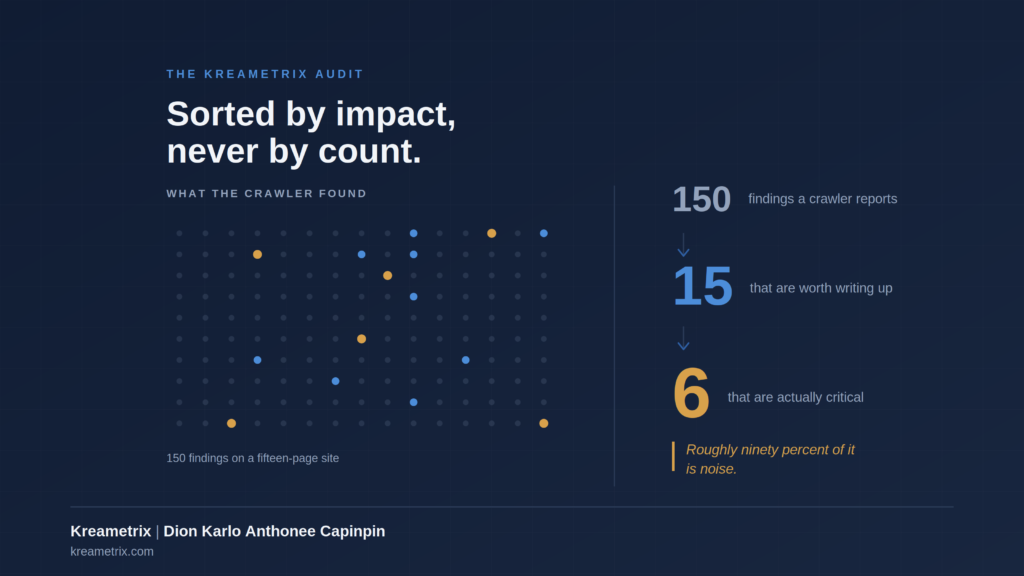
I start every engagement the same way, and it isn’t with a crawler.
I want to know why the business has a website at all.
Not the industry. The job. Is this thing supposed to generate quotes, take orders, book consultations, make the phone ring, or just exist so people who already heard your name can check you’re real? How does the business actually make money, and where is the site meant to fit into that?
Begin with the end in mind. Once I know what the site is for, I can work out where it’s failing to do that job. And once I know that, the direction is obvious.
Do it the other way round — crawl first, ask questions later — and you get what most people get handed. A hundred and fifty problems, sorted by a machine that has no idea what your business does.
Where a hundred and fifty problems come from
A crawler finds roughly ten issues per page. That’s not an exaggeration, it’s arithmetic. Run one on a fifteen-page business site and you’ll get somewhere between a hundred and two hundred findings.
You already know what they’ll be:
Meta descriptions missing, duplicated, too long, too short. Title tags too long or too short. Heading structure out of order. Low word count. No featured image. Images without alt text. Poor HTML-to-text ratio. Broken links. Pages with no internal or external links. Slow loading. Images that don’t load.
Every one of those is real. Every one is a genuine deviation from best practice. And you could work through the whole list, spend six weeks on it, and watch nothing change.
Of a hundred and fifty, I’d expect around fifteen to be worth writing up. Maybe six of those critical, depending on what’s going on technically.
Roughly ninety percent of it is noise.
Not wrong. Noise. Things that are technically true and make no difference to whether this business gets more customers.
The sorting problem
A crawler sorts by how many times each problem occurs, because that’s the only thing it can measure. Four hundred images without alt text goes to the top, because four hundred is a big number.
The thing actually stopping you from ranking sits at position eighty, mentioned once, because it only appeared once in the crawl.
The tool isn’t broken. It’s doing what it was built to do. It just has no way of knowing that one of your pages generates most of your enquiries and another hasn’t been visited by a human being in two years. It can’t know, because nobody told it what the business is for.
That’s the part a person has to do.
A site with almost seven hundred thousand impressions and almost no clicks.
A 3D laser scanning and as-built drawings business in the US. Good business, real demand, established domain.
Sixteen months of Search Console data showed 673,000 impressions producing 2,860 clicks. That’s a click-through rate of 0.4%, at an average position of 19.8.
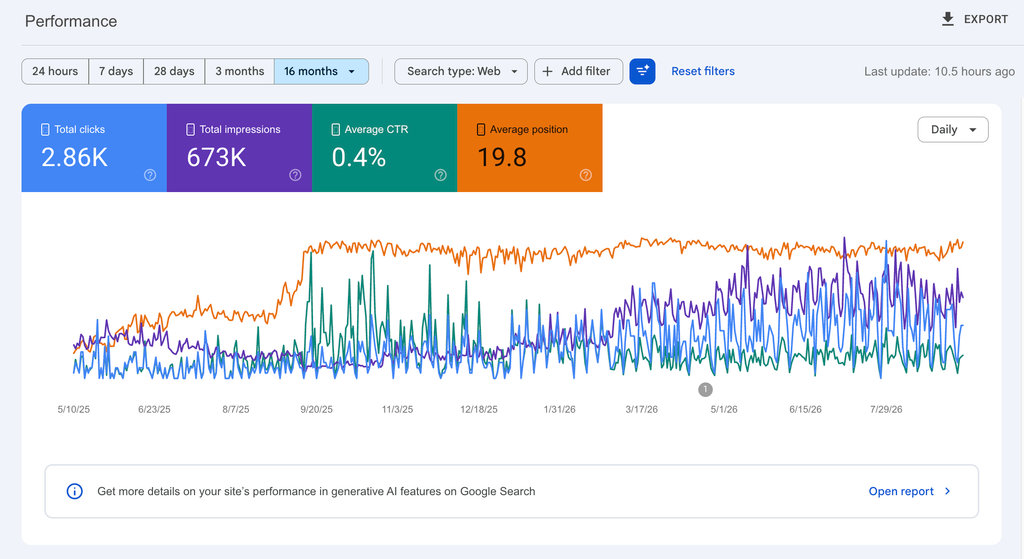
Read that again, because it’s the whole story. Six hundred thousand times, someone searched for something this business does, and Google showed them this site. Almost none of them clicked, because almost none of them ever saw it — position 22 is page three.
Demand was never the problem. Visibility was never the problem. The site was appearing constantly and converting none of it.
Now, what would a tool have told him? Meta descriptions. Alt text. Heading structure. All true, all present, all noise.
Here’s what was actually happening.
Twelve of his own URLs were competing for the same head term. The page that was supposed to rank for it came last, at one impression. All twelve returned zero clicks. He wasn’t losing to competitors on that term — he was losing to himself, twelve ways, and Google had given up trying to work out which page was the answer.
Seventy-nine pages indexed against a hundred and five not indexed, most of it near-duplicate content. The site had generated more pages than Google was willing to keep, so the crawler was spending its time on variations instead of the pages that sell.
And domain authority was 46 against the closest competitor’s 31. That matters because of what it rules out. He had more authority than the people beating him. It was never a link problem. It was structural, and no quantity of backlinks would have touched it.
That last figure is the one I’d point to if someone asks why I don’t lead with link building. The data said the links were fine. The structure wasn’t.
The GA4 problem, which is worse than people think
On the same engagement, I went into GA4 to establish a conversion baseline.
Roughly ninety percent of the sessions were non-human. Bot traffic concentrated in Singapore and a spread of proxy geographies, inflating every site-wide total in the account.
Every dashboard number this business had been looking at was wrong. Not slightly wrong — wrong enough that any priority list built on it would have been built on fiction. The only usable data in the whole property was the Organic Search segment, and that’s what I ended up working from.
This is why I validate analytics by hand before I trust a single number that comes out of it. Events that fire on page load instead of on form submission. Conversions counted twice. Tracking set up by someone who left three years ago that nobody has checked since.
If you build a priority list on numbers that were never true, you’ve made exactly the mistake the crawler made — sorted confidently by the wrong thing.
And it’s easy to fixate on traffic, because traffic is the number that goes up and the one everyone reports. It’s also the number that tells you least about whether the site is doing its job.
The part where I was wrong
Halfway through that engagement I’d recommended merging a set of informational pages into one consolidated pillar. Standard practice, and on paper it looked right.
Then I audited the content properly, page by page, and every one of them turned out to hold distinct territory — real impressions, real clicks, genuinely different queries. Merging them would have destroyed working assets to tidy up a diagram.
So I took the recommendation back and told the client why.
Every audit I write now includes a list of what I found, considered, and am deliberately not recommending action on, with the reason. Partly because it’s honest. Mostly because the judgement about what to leave alone is the part a tool can’t do, and it’s usually worth more than the list of things to fix.
Two canonical problems, and why nobody catches them
The findings I see ignored most often are canonical problems and cannibalisation. Not missed — tools flag both. Ignored. They sit mid-list, described in language nobody outside SEO understands, and they never make it into anyone’s priority order.
An e-commerce example, separate from the one above. A catalogue of more than three hundred products, most with colour and specification variants. Every variant generated its own URL, and every one carried a self-referencing canonical tag — each variant telling Google I’m the original, index me separately.
Three hundred products had become several thousand near-identical indexed URLs, all competing.
The fix, once the problem is named properly:
- Canonical the variants to the base product — same specs, different colour, one page
- Stop the template writing self-referencing canonicals to parameter URLs
- Disallow the low-value facet combinations in robots.txt
- Make internal linking agree — navigation, category grids and the XML sitemap pointing only at clean base URLs, with parameters stripped from “related products” and “customers also bought”
Result: one indexed page per product instead of every variation of it, and crawl budget back on the pages that sell.
Not dramatic-sounding. It’s the foundation everything else sits on, and no amount of new content fixes it.
“We need more content and more backlinks”
I hear this regularly, usually from owners who’ve worked with a consultant before or read enough to be dangerous.
They’re not wrong exactly. They’re out of sequence.
What I say is: let’s get the foundation right first. Fix what’s on the site, sort out the structure, make sure the pages you already have can be found and are actually competing for what they’re meant to. Then add. And when we add, we set content guidelines up front so we’re not back in eight months fixing the same problems across thirty new pages.
The scanning business above is the clearest case I’ve worked on. More content would have made the cannibalisation worse. More backlinks would have pointed authority at a structure that couldn’t use it. He already had more authority than his competitors — he was just spending it twelve ways on the same term.
Some people take that well. Some don’t, because it isn’t what the last person told them, and being asked to slow down sounds like being told no.
I understand that reaction. Someone in that position has usually paid for activity before — volume, output, a monthly report full of things that were done — and watched nothing move. Caution sounds like another version of the same thing.
Which is why I try to understand where the client is actually standing before I recommend anything. What they’re worried about. What they’ve tried. What they were promised last time and what happened instead. Real service comes from knowing where someone is, not from applying the same checklist to everyone.
Sometimes the site isn’t the problem
The most useful thing an audit can tell you is occasionally that search isn’t your constraint.
The traffic is fine. The rankings are fine. What’s broken is the offer, the pricing, the conversion path, or nobody following up on the enquiries that already arrive. No amount of technical SEO fixes any of that, and pretending otherwise is how people end up paying for eighteen months while nothing changes.
That answer costs me engagements sometimes. I’d still rather say it on the first call than in month six.
What to do with the audit you’re already holding
You don’t need to throw it out. You need to re-sort it.
Start with the business, not the list. What is this website supposed to do for you? Which pages carry that job? Write them down — there are probably fewer than ten.
Then ask one question of every row: does this affect one of those pages?
Most won’t. What’s left is usually short, and it’s the list you should have been given.
Then ask the harder question of what remains: if I fix this, what specifically do I expect to change? Not “it’s best practice” — what will actually be different. If nobody can answer that, it goes to the bottom.
And check your analytics before you trust any of it. Complete a conversion journey yourself and watch what fires. If ninety percent of your sessions are bots, every number you’ve been reporting is fiction.
That’s the method. Understand what the business needs the site to do. Find where the site fails to do it. Sort by impact, never by count.
Everything else is a spreadsheet. Every engagement I take on starts with the Kreametrix Audit — five stages, twelve audit areas, and a report that tells you what to fix, what to leave alone, and whether search is even your problem.