

Google Business Profile optimisation
Compliance first, then the profile
Categories, service areas, suspension risk and the listings, articles and schema that either corroborate your profile or contradict it. When Google can't verify a business as described, it overrides the fields and caps the visibility.
Prerequisite
Why the work runs in this order
Most Business Profile work is keyword stuffing with extra steps. Fill the services field, fill the description, fill the business name if you can get away with it. This isn’t that.
Google states that local results are based primarily on three things: relevance, how well a profile matches the search; distance, how far the business is from the customer; and prominence, how well known the business is.
Two of those can be improved. Distance can’t — you can’t move a business closer to a searcher. What you can do is make sure the address or service area accurately reflects where the business actually operates, so it competes in the right geography.
Underneath all three sits a condition that isn’t a ranking factor at all: whether Google can verify the business exists as described. Local search sends people to physical places, so accuracy matters more here than anywhere else in search. When a profile can’t be corroborated by the website, the directories and everything else published about the business, two things follow — fields get overridden, and visibility hits a ceiling no amount of profile optimisation lifts.
That’s the reasoning behind the sequence below. Compliance first, then relevance, then verification, then the signals that keep it current.
The work
The four stages
Each stage gates the next. Nothing downstream is worth doing until the stage above it holds.
1
Suspension risk
What gets examined: keyword stuffing in the business name, services and description. Address eligibility — PO boxes and mailboxes at remote locations aren’t permitted, and a service-area business should hide its address rather than display it. Residential addresses used as business locations. Service area boundaries, which Google caps at roughly two hours’ driving time from where the business is based. Phone number consistency. Current suspension status and any history of one.
What comes out: a written risk assessment — what’s non-compliant, what the exposure is, and what has to be corrected before anything else begins.
2
Categories and competitor mapping
What gets examined: the primary category, which determines which searches the profile is eligible for at all. Secondary categories. The categories used by the businesses actually ranking for the terms that matter. And where a business genuinely does two things — a music school that’s also a recording studio, a bakery that’s also a café — which category serves the commercial goal.
What comes out: primary and secondary category recommendations, mapped against what currently ranks rather than chosen from the list.
3
Entity alignment
What gets examined: everything that describes the business. The profile, the website’s schema, the site’s content, every directory listing, every published article and mention. Name, address, phone, services — and the way the business describes itself, which should sound the same everywhere.
This begins with discovery, because most businesses don’t know what’s out there: listings from a previous agency, profiles created by staff who left, aggregator entries nobody submitted, records carrying a former address or a disconnected number. The major citation platforms are worked through first and unclaimed listings claimed. A link audit then surfaces the long tail that platform-by-platform checking misses.
What comes out: a full inventory of what exists, what each source says, where the contradictions are, and a correction plan in priority order.
4
Activity and review signals
What gets examined: whether the profile reflects a live business. Hours accuracy including exceptions, services and products kept current, description accuracy, review volume and the pattern reviews arrive in, response rate and time, Q&A coverage, and post cadence.
Google states that more reviews and positive ratings can improve local ranking, and that responding to reviews helps. Reviews that arrive in a burst and then stop are a different signal from reviews that accumulate steadily.
What comes out: a review and activity plan that’s sustainable for the business to actually maintain, and doesn’t look manufactured.
Deliverable
What you receive
Suspension risk assessment
Every non-compliant element, the exposure it creates, and the order of correction.
Category and competitor analysis
Primary and secondary recommendations, with the categories used by currently ranking businesses.
Entity inventory
Every listing, citation and mention found, what each says, and where each contradicts the others.
Alignment plan
What changes on the profile, the website, the schema and each platform, sequenced.
Profile build-out
Categories, services, products, attributes, description and photos, implemented.
Review and activity plan
Cadence, request process, response approach.
Baseline and reporting
Profile interactions, calls, direction requests and website clicks recorded at the start, so change is measurable.
A walkthrough call
The work isn’t handed over as a spreadsheet.
Your side
What to expect
What I need from you
Owner or manager access to the Business Profile, access to the website and its CMS, and logins for any directory listings you know about. Plus the history: who has managed the profile before, whether it’s ever been suspended, and any changes to the address, phone number or business name. Most of the discovery I do myself, because most businesses don’t have that list.
The sequence
Compliance issues are corrected first, because a profile at risk of suspension isn’t worth optimising. Categories and profile build-out follow. Entity alignment runs longest — it depends on how much is out there and how much of it is wrong. Activity and review work starts once the underlying data is consistent and continues from there.
What you may be asked to do
Pause new content production while the existing estate is corrected. Inconsistent listings, pages and articles are already indexed and often linked to — they have to be fixed in place, and publishing more while they contradict each other just adds to the reconciliation. It’s the least popular recommendation I make, and it’s the one that determines whether the rest works.
Honesty
What this does not promise
No map pack position, and no date. When a profile has been inconsistent for a long time, restoring Google’s confidence in it means holding consistency long enough for Google to observe and reassess — weeks at minimum, often months. The observation window isn’t something anyone outside Google controls. Anyone giving you a date is guessing.
Which one you need
One location, or many
Single location
The full four stages on one profile, with entity alignment across the website and every platform the business appears on.
Deep rather than wide: one profile, one citation footprint, one website, corrected thoroughly.
Multiple locations
The same four stages, with three additional problems.
Discovery multiplies.
Every location carries its own listings and its own accumulated errors, and one branch’s bad data can undermine the others.
Locations can compete.
Branches in the same area can be filtered against each other, and category selection, profile structure and supporting pages determine whether they reinforce or cannibalise.
Shared addresses need separation.
Where more than one business operates from a single address, Google permits separate profiles only for genuinely distinct businesses — different names, visible signage differences, distinct categories and isolated contact details. Where they aren’t distinct, a second profile achieves nothing.
Proof
One result, with its source
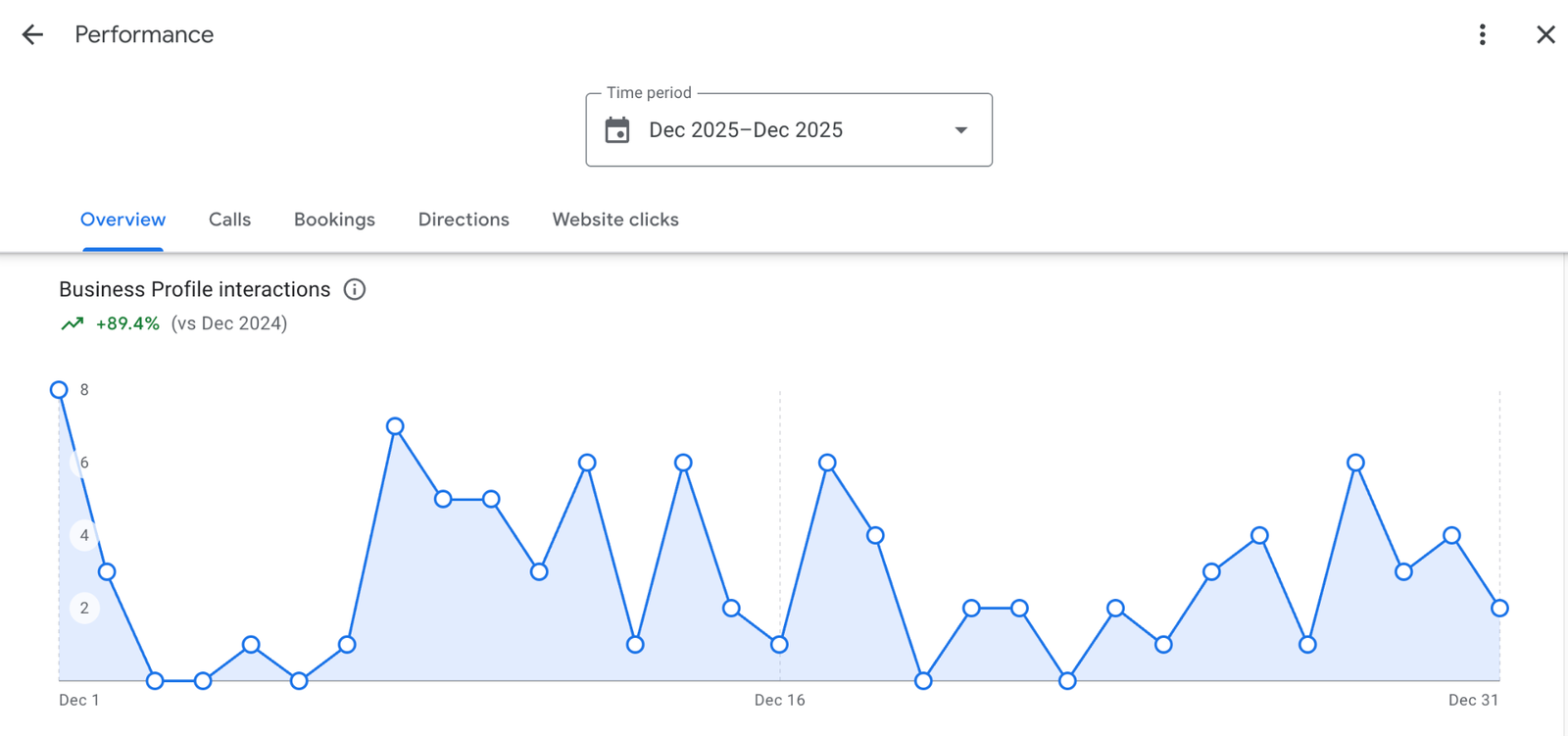
Profile interactions
A music school in Australia, also operating as a recording studio. Information inconsistent across platforms over a long period, fields stuffed, reviews arriving in an unnatural pattern, and a profile barely surfacing in results.
After alignment across the website, schema, profile, directories and published articles, and a rebuilt review and activity cadence:
+89.4%
Year-on-year increase in Google Business Profile interactions.
A small business with small numbers. What matters is that a profile which had been effectively invisible started being found consistently.
Who this is for
A good fit if you
- Have a real, staffed location or a genuine service area that meets Google’s guidelines
- Suspect the profile is underperforming and don’t know why
- Have had Google override your services, description or categories
- Inherited a profile from a previous agency and don’t know what was done to it
- Operate in more than one location and the listings have drifted apart
- Have been suspended, or think you’re at risk of it
Who this isn’t for
Not a good fit if you
- Want a map pack position guaranteed by a date
- Need a virtual, unstaffed or mailbox address to appear as a location
- Want reviews generated, gated or filtered
- Want the business name stuffed with keywords
- Want multiple profiles for what is really one business
- Aren’t willing to pause publishing while the existing estate is corrected
Boundaries
What’s not included
No guaranteed map pack rankings and no guaranteed timeline · no fake, virtual or unstaffed locations · no review gating, review generation or filtering negative reviews · no keyword stuffing in business names, services or descriptions · no citation building at volume, local landing page development or local link building — that’s separate work · no website development or content production.
Fake locations, gated reviews and stuffed names do produce faster results, and they’re why this market has the reputation it has. I don’t use them, and the reason is arithmetic rather than principle: Google iterates on local spam continuously, and anything built on manipulation is borrowing against a penalty you’ll eventually pay.
Delivery
Who does the work
Every Kreametrix engagement is conducted by Dion Karlo Anthonee Capinpin — not delegated, not white-labelled, not run by a junior against a template.
Sixteen years in SEO and digital marketing, including nearly nine years as a project manager at a digital agency, running campaigns for clients in the US and Australia. Top Rated Plus on Upwork with a 100% Job Success Score across 60+ completed projects.
Documented results include a telehealth client moved from page two to page one with a 125% increase in organic traffic over six months, an 89.4% year-on-year increase in Google Business Profile interactions (December 2024 vs December 2025), a 28% email conversion lift measured three months after a flow rebuild, and a recovered Google manual action.
Questions
Before you ask
Why does Google keep changing my business description and services?
Because it found a source it trusts more than your profile. Local search sends people to physical places, so Google weights accuracy heavily. When what your profile says doesn’t match your website, your schema, your directory listings and everything else published about the business, Google substitutes what the majority of its sources agree on. The override is a symptom of a profile Google can’t corroborate.
Will keyword stuffing my services and description help me rank?
No, and it usually makes things worse. Stuffed fields don’t match what your other platforms say, because those weren’t stuffed the same way. That inconsistency works against you, and it increases suspension risk. A service that appears only on your profile and nowhere else is an unverifiable claim.
How long does it take to see results?
There’s no fixed timeline, and anyone giving you one is guessing. If a profile has been inconsistent for years, restoring Google’s confidence means holding consistency long enough for Google to observe and reassess — weeks at minimum, often months. What I can tell you is what’s wrong and what the sequence of fixes is.
Can I have a Business Profile without showing my address?
Yes, if you’re a service-area business. Google’s guidelines say service-area businesses should hide the address and show a service area instead, and that PO boxes and mailboxes at remote locations aren’t acceptable. Google also caps a service area at roughly two hours’ driving time from where the business is based. Getting this wrong is one of the most common causes of suspension.
Do you do review generation or remove bad reviews?
No. I don’t generate reviews, gate them or filter negative ones. What I do is establish why reviews are arriving in an unnatural pattern and build a sustainable request and response process. Reviews that arrive in a burst and stop are a different signal from reviews that accumulate steadily. Reviews that genuinely violate Google’s policies can be reported through Google’s process, which isn’t the same as removing reviews you don’t like.
Is this the same as local SEO?
No. This engagement covers the Business Profile itself — suspension risk, categories, entity alignment, activity and review signals. Local SEO covers the work around it: location pages on your website, citation building at volume, local schema, local content and local link building. They support each other and often run together, but they’re quoted separately.
Next step
Before you commit to anything
A 30-minute call. Show me the profile and I’ll tell you what I’d expect to find, whether the problem is the profile or something around it, and whether this is worth doing at all.
Engagement
How it’s scoped
The optimisation itself is a one-time project — categories, service areas, attributes, the profile built out properly and the suspension risks cleared.
Monitoring and updates are ongoing. Profiles drift: Google changes categories, competitors file edits, reviews accumulate, and a listing that was correct six months ago often isn’t.
Related services